Archive for April, 2009

RHBH 2009 1st Quarter Building Permits

Monday, April 27th, 2009

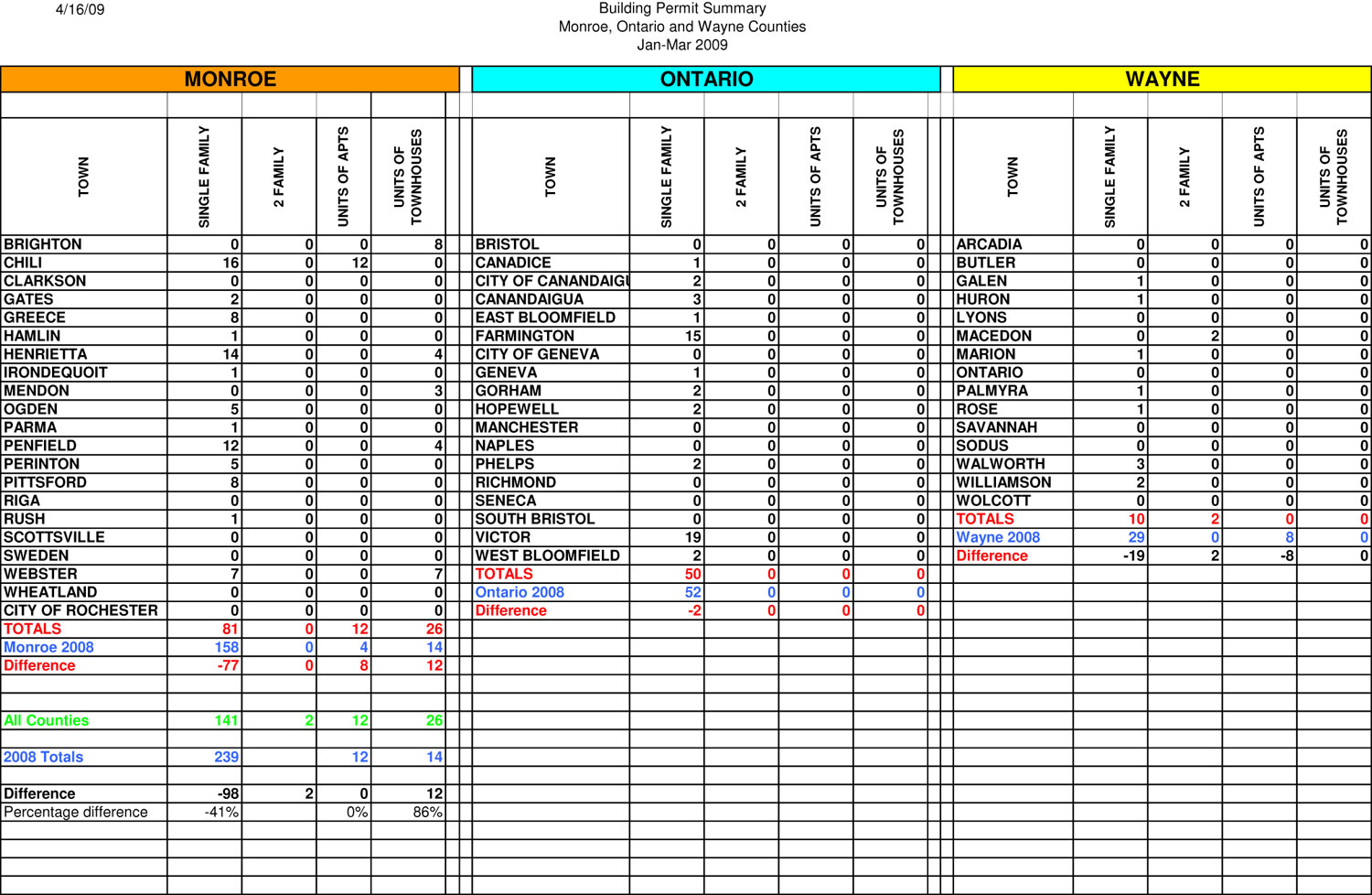
New home building permits in the Rochester area were down in the 1st QTR of 2009 by 98 permits. In 2008, 239 permits were applied for in Monroe, Wayne and Ontario counties and in 2009, 141 permits were applied for. Part of the decline was due to an unusually snowy and cold winter that did no allow builders to get early starts for the spring selling season. Although this is not unusual, the past few winters have not been as harsh and building continued almost without interruption even in those winter months. “Although building starts are down, the builder confidence level is up”, said Dawn Aprile, Chairman of the Rochester Home Builders’ Association. “Builders are reporting that traffic at their model homes has been very good the last few weeks as the weather has improved and the drop in interest rates is certainly a positive factor as well. Contracts are being written and we should see part of the decline made up in the 2nd QTR.” Aprile said.

Figures for new homes dropped by 77 permits in Monroe County from 158 in 2008 to 81 in 2009. Wayne County permits decreased by 19 from 29 in 2008 to10 in 2009. Ontario County remained consistent with 50 new home permits in the 1st QTR of this year versus 52 in 2008.

Chief Executive Officer of the Rochester Home Builders’ Association Rick Herman indicated that overall the builders are pleased with business comparing it to other parts of the country. “Comparable markets in the south, mid-west and west coast are experiencing much different and not so favorable conditions. Our area is very stable economically in large part due to the stability of our housing market. Our area builders recognized that a slow down in building was likely to occur and planned accordingly. When final 2009 figures are tabulated, we do expect 2009 to be similar to 2008 and we further expect that 2010 will be back to normal. That’s good news for the builders, but also the hundreds of other local businesses and thousands of jobs that depend on new home construction in our communities.”
 

In 2009 the Rochester Home Builders’ Association (RHBA) and its nearly 400 business members are celebrating the association’s 75th anniversary. Incorporated in 1934 the Rochester Home Builders’ Association is one of the original eight associations that helped to form the National Association of Home Builders (NAHB) in Washington, D.C. Seventy five years later NAHB has more than 800 chapters across the country, and the Rochester Home Builders’ Association is one of the strongest and most active of the 16 chapters in New York State. The RHBA is a trade association of home builders, remodelers, general contractors, trades, suppliers, lending institutions and many other businesses that support the building and remodeling industries. Find out more at www.rochesterhomebuilders.com.
GRAR 2009 1st Quarter Home Stats

Monday, April 27th, 2009

Uncertainty Kept Potential Homebuyers Guessing

REALTORS® Remain Optimistic About Housing Market’s Future

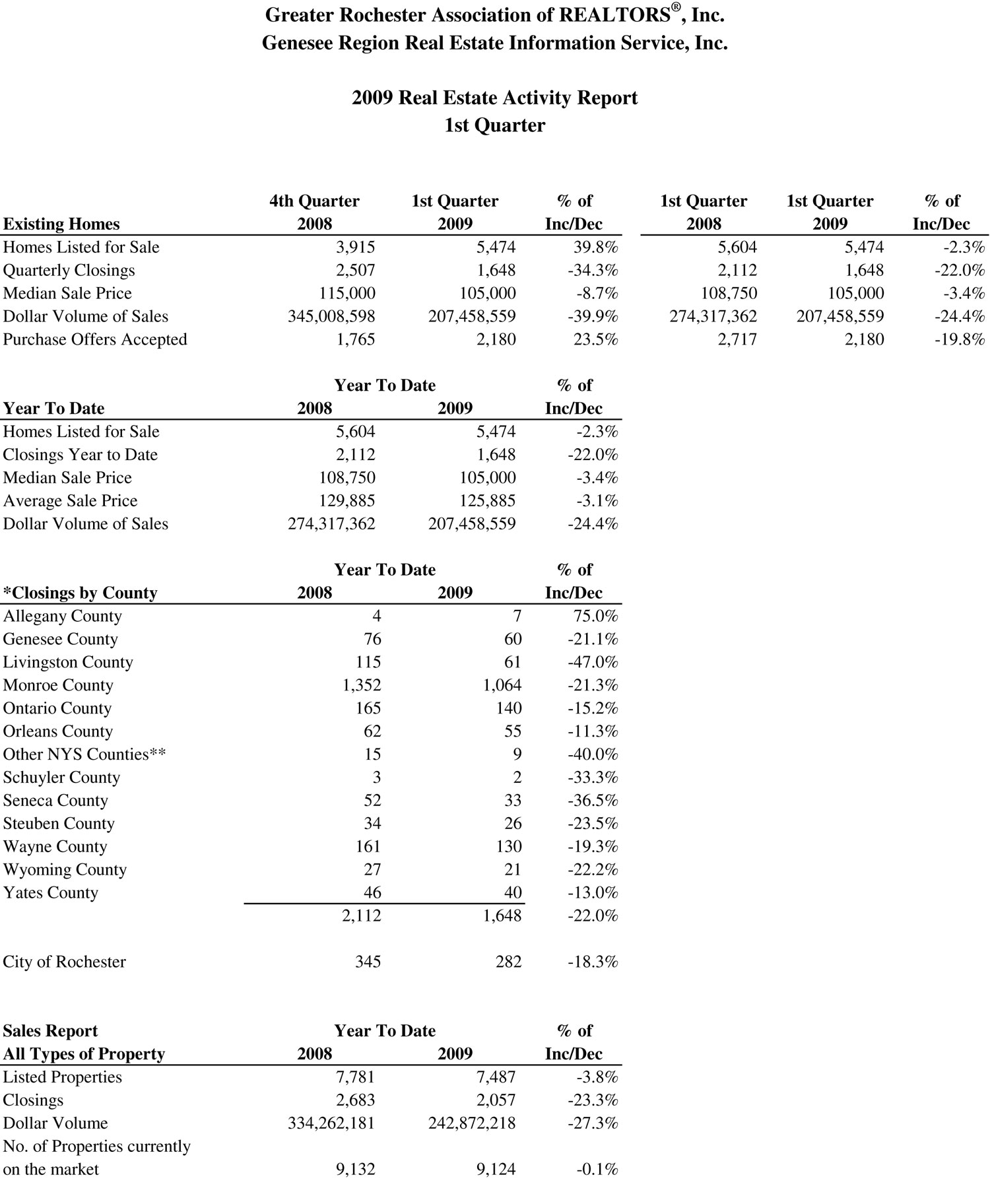
In spite of a sluggish 2009 First Quarter, local area REALTORS® continue to be optimistic about the future of the local real estate market. Statistics released by the Genesee Region Real Estate Information Services (GENRIS), the information subsidiary of the Greater Rochester Association of REALTORS® (GRAR), show that Greater Rochester REALTORS® sold 1,648 existing single-family homes in First Quarter 2009, a 33.4 percent decrease, compared to the Fourth Quarter 2008 and a 22 percent decrease, in contrast to First Quarter 2008. Although a reported decline in sales can be attributed to potential buyers’ concerns about the economy, initial expectations by the local real estate industry for the upcoming spring/summer season are pointing toward a more active market. GRAR also reported a pending sales surge of 23.5 percent in First Quarter 2009, as compared to Fourth Quarter 2008, which they attribute to an increase in first-time home buyers, in response to the recent federal tax credit stimulus and record low interest rates.

“We continue to be optimistic about the Rochester market,” said Ryan Tucholski, GRAR Chief Executive Officer. “Although our local real estate industry has been a little slow compared to last year at this time, the Rochester area has not experienced the dramatic downturn that many other cities across the country have encountered.”

Tucholski emphasized that the resilience of the Rochester area market can be attributed to stability in home values. “People believe that owning a home is still one of the best investment options they can make.”

“The soft housing marketing this past quarter was not unexpected, as many would-be buyers were stranded on the sidelines by the economic news of the day and held there by the uncertainty of the federal government’s response,” said Chuck Hilbert, GRAR Board of Directors president. “We are hearing from our members throughout the region that potential homebuyers are showing more interest and buying homes.”

The median sale price for the region dropped only slightly to 3.4 percent to $105,000 in First Quarter 2009, compared to the same time frame in 2008.

How Can I Make The Open House The Best It Can Be?

Monday, April 27th, 2009

Dear JMan, I have listed my home for sale and my agent would like to market our home using open houses.  How can I make the open house the best it can be?

According to the National Association of Realtors 2008 Survey of home buyers and sellers, Open houses were ranked third on methods that agents used to market all types of homes. If you choose to have an open house it is wise to do put your best foot forward and really make your home shine. Buyers may not be able to visualize a properties potential and you really don’t get a second chance to make a first impression. I am including two reports to help you with your open house. The first is 7 steps to preparing for an Open House and the second is 10 ways to make your home irresistible at an open house. I hope it helps your open house’s “be all it can be”

7 Steps to Preparing for an Open House

1. Hire a cleaning service. A spotlessly clean home is essential; dirt will turn off a prospect faster than anything.

2. Mow your lawn, and be sure toys and yard equipment are put away.

3. Serve cookies, coffee, and soft drinks. It creates a welcoming touch. But be sure the kitchen has been cleaned up; use disposable cups so the sink doesn’t fill up.

4. Lock up your valuables, jewelry, and money. Although the real estate salesperson will be on site during the open house, it’s impossible to watch everyone all the time.

5. Turn on all the lights. Even in the daytime, incandescent lights add sparkle.

6. Send your pets to a neighbor or take them outside. If that’s not possible, crate them or confine them to one room (a basement or bath), and let the salesperson know where to find them.

7. Leave. It’s awkward for prospective buyers to look in your closets and express their opinions of your home with you there.

10 Ways to Make Your Home Irresistible at an Open House

1. Put fresh or silk flowers in principal rooms for a touch of color.

2. Add a new shower curtain, fresh towels, and new guest soaps to every bath.

3. Set out potpourri or fresh baked goods for a homey smell.

4. Set the table with pretty dishes and candles.

5. Buy a fresh doormat with a clever saying.

6. Take one or two major pieces of furniture out of every room to create a sense of spaciousness.

7. Put away kitchen appliances and personal bathroom items to give the illusion of more counter space.

8. Lay a fire in the fireplace. Or put a basket of flowers there if it’s not in use.

9. Depersonalize the rooms by putting away family photos, mementos, and distinctive artwork.

10. Turn on the sprinklers for 30 minutes to make the lawn sparkle.

For all of your real estate answers send AskJMan@JManSells.com

The Natural Kitchen

Thursday, April 16th, 2009

by Brenna Hartmann

Looking for a home improvement you can really sink your teeth into?  Consider an edible wall! 

Imagine having fresh dill for a homemade veggie dip, some chives for your sour cream or even lettuce for a fresh picked spring salad…all year long, right at your fingertips!  Sound delicious?  Trust me, it is.  Fresh, fragrant, organically grown herbs and veggies ripe for the picking from your own kitchen garden.  That’s right, you can have a vertical herb garden right in the heart of your home growing on your wall!  A relatively new concept here on the East coast, it is fast taking hold as people seek greener and healthier lifestyles.

One of my home improvement themes this year is designing a “natural” kitchen.  I began my project by eliminating  chemically toxic cleaning products and replacing them with my own home  brewed products consisting of eco-friendly ingredients like baking soda and vinegar.

I have regularly been replacing damaged and scratched non-stick cookware and plastics with more enviro-friendly and reusable products like glass storage containers and stainless steel cookware.

I have upgraded to energy efficient appliances and have installed dimmer switches.  I am using Energy Star rated light fixtures and bulbs.  So what’s next?  Naturally…the food I am preparing and eating.  But, like many homeowners, I have limited  horizontal space for growing fresh herbs and vegetables and my short outdoor growing season is further limited by the climate here in upstate New York.  Now, thanks to Green Living Technologies, I am  growing fresh herbs and lettuce right on my kitchen wall!  I have installed an edible, vertical garden.  Complete with automatic lighting and irrigation system, this simple modular panel construction allows me to grow my own organic produce year round!

My edible wall is by far my favorite home improvement project to date.  The aroma of the fresh cut herbs is indescribable and for a fraction of the amount of money I would spend growing annually or purchasing costly store bought herbs, I have a beautiful, sustainable and eco-friendly garden wall, right in the heart of my home.

As an added benefit, the plants in my edible wall also serve as air purifiers.  You may be aware that formaldehyde is emitted from many products in our homes such as carpet, plywood, particle board, adhesives and even draperies.  The leaves and the stems of the plants in my edible wall absorb the volatiles during the day and the root zone continues the work at night.  Now that’s a great green bonus!

I am delighted and proud to have a natural kitchen.  Now I just have to learn how to cook! 

You can view a video of the installation by clicking the link “Living Greener” on my website www.homeandyardradio.com.  

Brenna Hartmann is the co-founder of Fixin’Chix Inc., a do-it-yourself enterprise that includes a comprehensive home improvement website; how-to workshops, seminars and publications; and a product line. Brenna is dedicated to empowering women “do-it herselfers” (DIHers) who have the passion and desire to improve their homes. Brenna writes the popular Fixie Chick home improvement column found in Home & Yard Handbook, and is the co-host of “Home & Yard Radio with the Fixie Chick” on 950 ESPN. Brenna lives in Webster with her husband and two children.  

What do I need to know about buying the insurance and how can I keep my costs down without sacrificing coverage?

Monday, April 13th, 2009

DEAR JMAN, I am in contract for the purchase of my first home. My attorney called and said I need to purchase insurance for the home prior to closing. What do I need to know about buying the insurance and how can I keep my costs down without sacrificing coverage?

I have enclosed two reports. One is 5 things to understand about insurance and the other is 10 ways to lower your insurance costs.

5 Things to Understand About Homeowners Insurance

1. Look for exclusions to coverage. For example, most insurance policies do not cover flood or earthquake damage as a standard item. These coverages must be bought separately.

2. Look for dollar limitations on claims. Even if you are covered for a risk, there may a limit on how much the insurer will pay. For example, many policies limit the amount paid for stolen jewelry unless items are insured separately.

3. Understand replacement cost. If your home is destroyed you’ll receive money to replace it only to the maximum of your coverage, so be sure your insurance is sufficient. This means that if your home is insured for $150,000 and it costs $180,000 to replace it, you’ll only receive $150,000.

4. Understand actual cash value. If you choose not to replace your home when it’s destroyed, you’ll receive replacement cost, less depreciation. This is called actual cash value.

5. Understand liability. Generally your homeowners insurance covers you for accidents that happen to other people on your property, including medical care, court costs, and awards by the court. However, there is usually an upper limit to the amount of coverage provided. Be sure that it’s sufficient if you have significant assets.

10 Ways to Lower Your Homeowners Insurance Costs

1. Raise your deductible. If you can afford to pay more toward a loss that occurs, your premiums will be lower.

2. Buy your homeowners and auto policies from the same company. You’ll usually qualify for a discount. But make sure that the savings really yields the lowest price.

3. Make your home less susceptible to damage. Keep roofs and drains in good repair. Retrofit your house to protect against natural disasters common to your area.

4. Keep your home safer. Install smoke detectors, burglar alarms, and dead-bolt locks. All of these will usually qualify for a discount.

5. Be sure you insure your house for the correct amount. Remember, you’re covering replacement cost, not market value.

6. Ask about other discounts. For example, retirees who are home more than working people may qualify for a discount on theft insurance.

7. Stay with the same insurer. Especially in today’s tight insurance market, your current vendor is more likely to give you a good price.

8. See if you belong to any groups—associations, alumni groups—that offer lower insurance rates.

9. Review your policy limits and the value of your home and possessions annually. Some items depreciate and may not need as much coverage.

10. See if there’s a government-backed insurance plan. In some high-risk areas, such as the coasts, federal or state governments may back plans to lower rates. Ask your agent.

For all of your real estate answers send AskJMan@JManSells.com

Nothnagle Realtors Ranked 34th Most Productive Firm in Nation

Wednesday, April 8th, 2009

Nothnagle Realtors proudly announces that the company has been ranked the 34th most productive company in the country on two national surveys. The surveys were released by REAL Trends 500 and RIS Media.

Both reports rank the largest residential real estate firms in the nation based on varying sales criteria. Nothnagle is ranked 34th most productive company based on transaction sides for 2008. The surveys are considered the most trusted standard of measuring the performance of national real estate firms.

Last year, Nothnagle was ranked 36th on the surveys. While some companies moved up on the list due to acquisitions and growth outside of their primary market area, the move up for Nothnagle was based solely on growth within Rochester.

While 2008 was a difficult year for real estate, Nothnagle’s market participation hit an all-time high. In the 61-year history of the company, the greatest growth spurts have occurred in challenging markets.

“It is a testament to the expertise of our local agents, combined with Nothnagle’s history of innovation and our comprehensive advertising programs, that our company could achieve this level of success at the national level,” stated Armand D’Alfonso, President and CEO. “Nothnagle is unique among some of the survey participants in that our business is based in the Greater Rochester region and we have fewer agents doing more transactions.”

Eliminate Fear And Confusion

Thursday, April 2nd, 2009

by Rich Levin

In a CNN interview Warren Buffet was talking about coping with the current economy. He said, “If you are fearful and confused, you don’t get over being fearful until you get over being confused.”

This speaks directly to the role of Real Estate Agents, Brokers, and all of us in the profession who are actively working with the public or Agents. Our role is to reduce and eliminate the confusion in our Clients, our spheres of influence, and everyone that we encounter. Reduce and eliminate the confusion so that our public is able to reduce and eliminate the fears they have in this economy. 

Accurate information eliminates confusion. When a person is driving at night in an unknown area and finds themselves lost and confused, a GPS, a map, or a person giving directions provides accurate information and eliminates the confusion. Immediately, as the confusion dissipates, the information begins to reduce the fear. 

Accurate information about the values in your community, the availability of mortgage money, the inventory, number of sales along with a few words of honest interpretation reduces the confusion to your public in two ways. First, the information by its nature reduces confusion. Remember, you may still be in a strange place but when you know where you are, you are less fearful than if you are lost. Second, when your public knows that they can depend on you for accurate, honest information they are less confused and less fearful because they have you as a source of accurate information on which they can depend. This liberates them from their fear to once again make plans about their Real Estate needs and look to you to fulfill their plans. 

You become the honest expert to your public. When you are the source of reducing confusion and fear you accomplish the ultimate goal of personal marketing. You are top of mind in the category of Real Estate.  When they think Real Estate they think of you (with confidence and comfort). When they think of you they think of Real Estate with more confidence and comfort. 

Many markets around the country are experiencing a strong early spring market. Buyers are active. In some areas the inventory of salable homes is low and it is looking and feeling a lot like the early stages of a Seller’s market. In these areas in addition to being the “Honest Expert” I have been teaching Real Estate Agents to be the “Optimistic Expert.” 

In healthier markets, and there are many of them this spring, convey the message that despite the negative economic conditions in many sectors, residential Real Estate is very healthy. Convey that Real Estate has led the economy into and out of its past two recessions. It led the economy into this one and is very likely to lead the economy back to health. In fact, as I write this (3/09) it looks very much like that is happening in many markets

Convey that there has not been a better time for first time Buyers to buy, in decades. The same is true for homeowners moving up from healthier, modest price ranges to softer higher priced homes in the same metropolitan areas.  Investors, who have financing, are finding incredible opportunities that are not often seen.

When an Agent gets one of the inevitable questions, “How’s Real Estate?”  “How’s the Real Estate market? Or, “How’s business?” Answer honestly and optimistically, “Some segments are soft but there is tremendous opportunity for first time home Buyers, a lot of people wanting to move up and investors are finding fabulous opportunities. Are you thinking about doing something, or know someone who is?”  Be the honest and/or optimistic expert. 

In every conversation, presentation, communication, and marketing material, in print and online, talk about and write about the honest scenarios, with intelligent insight, that is likely to help people be more confident, less confused, less fearful; that is likely to help people decide that it could be a good time to buy or sell.

There is no greater way for you and us in Real Estate to contribute to the health and recovery of this economy. There is no better way for us to contribute to the speed of recovery out of this recession than to reduce confusion and fear; by actively being the optimistic and/or honest expert to our public. 

There is also no better way for an Agent to be more successful in this market; no better way for an Agent to achieve his or her own optimism. As Marianne Williamson wrote in her poem that Nelson Mandela read in his inaugural speech “As we are liberated from our fear, our presence automatically liberates others.”

Let your light shine. 

To do our part I am conducting free live webinars every weekday morning at 8:45 am EST to motivate Agents across North America, lead them to eliminate confusion and reduce fear in their work and their lives; so they can be motivated and reminded every day that they have tremendous influence on the thinking and behavior in their marketplace. And that collective influence can have a direct and significant effect that ripples through the entire economy. (www.1stFifteen.com)

Rich Levin is a National Real Estate Authority with over 30 years experience; the last 15 dedicated to coaching and speaking. His specialty is in raising Agent Production while improving quality of life.  He has spoken in 38 States at events from small offices to the NAR convention.

Join our Success Community to receive more articles, tips and information. Contact us at 585-244-2700 or visit http://www.RichLevin.com.

Planning A Staycation This Year?

Thursday, April 2nd, 2009

by Brenna Hartmann

Respect the “Staycation” and discover the art of taking time off at home!

If you are among the many who are opting out of a pricey out of town vacation this year, you may be looking for ideas on what to do during your “spring break”. You may not have got that hefty bonus this year but hopefully you still get that paid time off.

“Staycations” describe a growing movement among folks who are spending their downtime right at home.  The problem is, it’s hard to get away at home. The laundry piles up, the grass keeps growing and your neighbor still runs his leaf blower at 7 pm. All can put a damper on your downtime. Don’t get discouraged yet. There are a variety of ways to get the most out of your at-home get away!

• Schedule your staycation just as you would an away vacation. Run your errands, catch up on your home and yard chores and let your co-workers, friends and neighbors know that you are taking a staycation before the time comes. 

• Hold your mail for the duration of your staycation and pre-arrange any deliveries and contracted lawn maintenance.

• Decide on a budget. If you don’t own a hot tub, consider renting a soft tub for the week. If you have kids, check out a party rental store for fun ideas. Bounce houses can be fun for grown-ups too.

• Make a staycation itinerary. You may prefer to be spontaneous, but some people find that being at home can guilt them into chores or projects. If you make a schedule you’ll be more likely to do stimulating activities, instead of thinking about what needs to be done around the house.

• Make a list of attractions in your area. Engage your family in planning places to visit. Include activities for weather fair and foul.

• Unless it’s one of your favorite things to do, don’t cook. Make dinner reservations-you’ll be more likely to stick to them. Be adventurous, exotic or romantic. Anything but homestyle.

• Consider asking a relative to sit your pets. It’ll be nice to be able to come and go on your own schedule without concern for their care.

Follow these tips and your staycation can feel like a real vacation with significantly less expense and stress. Relax and enjoy… and don’t forget to sleep in a little!  

Frequently Asked questions About the Home Buyer Tax Credit

Thursday, April 2nd, 2009

1.  WHO IS ELIGIBLE TO CLAIM THE TAX CREDIT?

First-time home buyers purchasing any kind of home new or resale are eligible for the tax credit. To qualify for the tax credit, a home purchase must occur on or after January 1, 2009 and before December 1, 2009. For the purpose of the tax credit, the purchase date is the date when closing occurs and the title to the property transfers to the new home owner.

2.  WHAT IS THE DEFINITION OF A FIRST-TIME HOME BUYER?

The law defines a “First-Tie home buyer” as a buyer who has not owned a principal residence during the three year period prior to the purchase. For married taxpayers, the law tests the homeownership history of both the home buyer and his/her spouse.

3.  HOW IS THIS HOME BUYER TAX CREDIT DIFFERENT FROM THE TAX CREDIT THE CONGRESS ENACTED IN JULY OF 2008?

The most significant difference is that this tax credit does not have to be repaid; the previous “credit” was essentially an interest-free loan. This tax incentive is a true tax credit. However, home buyers must use the residence as a principal residence for at least three years or face recapture of the tax credit amount. Certain exceptions apply. 

4.  HOW DO I CLAIM THE TAX CREDIT?

Participating in the tax credit program is easy. You claim the tax credit on your federal income tax return. Specifically, home buyers should complete IRS Form 5405 to determine their tax credit amount, and then claim this amount on Line 69 of their 1040 income tax return. No other applications or forms are required, and no pre-approval is necessary. However, you will want to be sure that you qualify for the credit under the income limits and first-time home buyer tests.

5.  WHAT TYPES OF HOMES WILL QUALIFY FOR THE TAX CREDIT?

Any home that will be used as a principal residence will qualify for the credit. This includes single-family detached homes, attached homes like townhouses and condominiums, manufactured homes (also known as mobile homes) and houseboats. The definition of principal residence is identical to the one used to determined whether you may qualify for the $250,000 / $500.000 capital gain tax exclusion for principal residences.

6.  INSTEAD OF BUYING A NEW HOME FROM A HOME BUILDER, I HIRED A  CONTRACTOR TO CONSTRUCT A HOME ON A LOT THAT I ALREADY OWN. DO I STILL QUALIFY FOR THAT TAX CREDIT?

Yes. For the purpose of the home buyer tax credit, a principal residence that is constructed by the home owner is treated by the tax code as having been “purchased” on the date the owner first occupies the house. In this situation, the date of first occupancy must be on or after January 1, 2009 and before December 1, 2009.

In contrast, for newly-constructed homes bought from a home builder, eligibility for the tax credit is determined by the settlement date.