Archive for August, 2009

The Secret to Your Success

Thursday, August 20th, 2009

In tough economic times, it is a natural for a Real Estate Agent’s attitude to waver. This market leads to confusion and lost focus. Should you make more calls, do more marketing, hold open houses, finally get to that project? What if none of those things work? Should you stay in the business? Can you afford to? These thoughts and the feelings they generate are a far more serious issue than the market and the problems that arise from the market.

You create what you focus on. Your focus creates your life. There are always opportunities in Real Estate. The Agents who looks for the opportunities find them, explore them and find ways to win. The Agents that look at the problems find those explore them and only see ways that limit their opportunities.

Focus creates feelings. The quality of our life is dictated by what we feel at any given moment. Focus creates your attitude. Do you control what you focus on and what you think about? Or do you allow outside influences, circumstances, and others reactions to dictate your focus which means that you, unnecessarily, give up control over your attitude and emotional state allowing outside influences to control the quality of your life?

Your Focus is the Key

Think about this. If a hostage is blindfolded, gagged and bound, in silence, what do they have left? All they have left are their thoughts and feelings. Through that experience, those thoughts and feelings completely dictate their quality of life. And how they manage those thoughts and feelings through that experience will largely dictate the quality of their life after it.

What you think about, you bring about. By managing what you think about, what you focus on you have power over your thoughts and their feelings.

This is true every day and every moment of your life. How you manage your focus will dictate your attitude. You can focus on things that make you strong and clear or focus on things that will diminish your quality of life.

Louise L. Hay, Author of “You Can Heal Your Life” says, “What we think about ourselves becomes the truth for us. Put another way, our subconscious mind accepts whatever we choose to believe. Then it reflects our beliefs in our lives. Many of us have foolish ideas about who we are. When we are very little, we learn how to feel about ourselves and about life by the reactions of the adults around us. When we grow up we have a tendency to re-recreate the emotional environment of our early home life.”

Our subconscious mind accepts whatever we choose to believe. You manage your attitude and your life by choosing the thoughts you focus on and hold in your mind. Choose empowering thoughts and you control the life you live. Allow disempowering thoughts and you lose control.

Focus Leads to Feelings

Focus leads to feelings. Control the focus and the feeling follows. You hear good news; good thoughts and good feelings follow. You hear bad news and bad feelings follow. Feelings follow focus, so control what you focus on and you control your feelings.

Focus, Meaning, and Physiology

Anthony Robbins, the famous motivator refers to this as your “state,” your emotional state of being. He teaches millions of people all over the world to control their state by controlling “what you focus on and the meaning you give it.” He adds a very important dimension to this. He adds physiology, which is what you do with your body.

Robbins says, “The source of all emotion is a pattern of physiology, how you use your physical body, focus, whatever you focus on, and meaning, words we put to an experience. Change any of these, physiology, focus or meaning and your (emotional) state changes.”

Most people do not make an effort to control their emotional state. Most people live with emotional states that disturb them. And they make no effort to change it, perhaps because they do not know that it is possible to change from sadness, frustration, fatigue and other negative emotional states to positive ones by changing focus, meaning and physiology.

The Secret

A popular DVD/book called “The Secret” focuses on the Law of Attraction. The narrator says, “By the images we hold in our mind we get and become what we think about most. What we think about we bring about.”

That is exactly what controls our attitude. What we think about (focus on) dictates the attitude we bring about.

It’s important to acknowledge that we cannot control the thoughts that pop into our minds. However, we can control whether we hold onto a thought, let it go, or replace it. We do not have to be controlled by the thought that popped into our mind but we are controlled by the thoughts we choose to hold there or allow to remain on our mind.

Habits and Practices

All this contributes to the way you create your attitude of success. The obvious goal is to fill your mind with the thoughts of what you desire. Fill your mind with belief in your confidence to live the life you desire, a life you love. And create the habit of catching negative, disempowering thoughts and replace them with positive, empowering thoughts. Here’s how.

You break an age old habit that is taught and reinforced by nearly everyone in our society. The age old habit is to focus on what to do. You go to bed each night and/or wake each morning and you shape your day around what you have to do. That focus will nearly always be frustrating. You may be asking what else is there to focus on?

The answer is to focus on what you want (not what you want to do), what you want to accomplish? What do you want to achieve? What do you want to create? Then focus on why you want those things. Once you are clear on what you want and why; your to do list becomes the vehicle instead of the goal, itself. Break the habit of the letting your day be dictated by your to do list. Instead let your day be led by what you want to achieve and why you want it. Your days will be more productive, more satisfying and more fulfilling.

Daily Affirmations and the What/Why Focus

Daily affirmations are the method to fill your mind with the exact thoughts that will empower your day. One of your daily affirmations may be remembering what you want and why you want it. For some, daily prayer is their focus and one set of thoughts that fill your mind. Other universal affirmations are; “I am completely capable.” “Money flows to me quickly and easily.” “I like myself unconditionally.” “I am loved and lovable.” “I deserve tremendous success.” Others may be specific; “I am earning two hundred thousand dollars this year.” “I am the number one Agent in my company.” “Seller’s are eager to hire me.” Or personal, “My family comes first.” “My work serves my life, not my life serving my work.”

As you repeat each affirmation or focus on what you want and why, take a moment to hold the image in your mind. Believe it is already yours. Hold the image long enough to actually feel that it is already accomplished. Experience that feeling. This is the actual practice of focusing on what you want, holding it in your mind and adding meaning to it. Results will come naturally. You don’t need to know how you will do a thing. Replace doubt with faith. Then your mind and heart are free to creatively come up with the best methods. Results naturally follow.

Physiology Again

As mentioned earlier, physiology is a main factor in your emotional state. As you experience your daily affirmations stand tall. If you feel like raising your arms toward the sky and letting the power of your faith flow through to you, raise them, smile and feel the glory of your success.

Physiology is a key to shifting your attitude. If you find your mind getting negative during the day, change your physiology. Go for a walk. Eat a piece of your favorite fruit. Simply stand up; clap your hands and begin thinking of your success; jump up and down, pump your fist. Feel the power of your successful future.

Physiology also includes exercise, diet, and sleep. When I see my thoughts go awry, or when I wake up and question my abilities or at some point in the day I find my mind losing belief in myself, the first questions I ask are, “Did I get enough sleep? Have I been exercising regularly? Did I miss meals or eat too much junk food recently?” Most often one of those is the reason. I commit to address the problem. That makes it easy to use positive physiology, focus and meaning to shift my attitude to positive.

In Summary

The most prescribed drugs in the United States are anti-depressants. Clinical depression is a debilitating disorder. At the same time most people are pretty normal when it comes to their attitude. It is perfectly normal to suffer from mild non-clinical depression. Many of my coaching clients who were in that state are now living happier more successful lives simply by employing the strategies above.

Reread the strategies above. Look at your goals, what you want and why. Set goals, or set new specific ones. Repeat your daily affirmations or create new ones. Start every day and focus each day on what you want and why. Make that a habit. Add physiology to your affirmations and change your physiology when your thoughts begin to sour. Look at your diet, exercise, and sleep habits. Make one small improvement. See its positive effect. Then make another.

With practice attitude shifts take no time at all. They happen in an instant. Make your next instant a powerful and positive one because you control it.

Rich Levin is a coach and speaker whose focus is teaching Agents to understand and control their business. Through that understanding achieve exceptional happiness and wealth in their life. Take control of your business, register for a 2009 Strategy Session.

Rich conducts a 15 minute webinar that will start your day with focus 1st Fifteen Training Webinar every week day morning. Rich is President of Rich Levin’s Success Corps Inc. Contact him at 585-244-2700 or rich@richlevin.com.

Federal Reserve Board Changes May Cause Potential Delays In Securing Mortgage Loans

Monday, August 17th, 2009

Under the recently adopted Federal Reserve Board Regulation Z amendment, the timeframe for securing a mortgage may prove to be challenging for some borrowers. The new rule takes effect on July 30, 2009 and applies to loan applications filed on or after that date. Its purpose is to better protect consumers and to help promote responsible lending practices. It also sets up advertising standards and requires that mortgage disclosures are provided to borrowers earlier in the transaction.

Here are some of the key highlights:

• The new requirements apply to all mortgages secured by a borrower’s home, including primary and second homes and refinances. Investor loans continue to be exempt.

• Lenders must give good faith estimates of mortgage loan costs within three business days after the consumer applies for a loan (early disclosure). The lender may not collect any fees before the disclosure is provided, except for a reasonable fee for obtaining a credit report.

• The closing may not take place until expiration of a seven-day waiting period after the consumer receives the early disclosure.

Consumers may shorten or waive the three-day and/or seven-day waiting periods for a “bona fide personal financial emergency,” but only after receiving an accurate Truth in Lending Act (TILA) disclosure. In the final rule’s preamble, the Fed stated that it “believes waivers should not be used routinely to expedite consummation for reasons of convenience.” The Fed decided not to insulate lenders from liability even where a consumer modifies or waives the waiting periods.

If the annual percentage rate (APR) changes by more than 0.125 percent, the lender must provide a corrected disclosure to the borrower and wait an additional three business days before closing the loan.  The APR includes not only the interest rate on the loan but certain other costs related to settlement, so it will be important for any fees that affect the APR to be as accurate as possible, as early as possible, to minimize the need for a corrected TILA disclosure.

Ryan J. Tucholski, CEO

Greater Rochester Association of REALTORS®

Chuck D. Hilbert, President

Board of Directors

Greater Rochester Association of REALTORS

My Journey To Energy Efficiency

Monday, August 17th, 2009

You may have read my blogs, listened to me on the Home&Yard Radio Show or read my columns here and in the Property Source Online regarding new Federal tax credits available to homeowners who are considering a home improvement designed to increase energy efficiency. To re-cap, in February of 2009, President Obama signed a stimulus bill (The American Recovery and Reinvestment Act of 2009) that made some significant changes to the energy efficiency tax credits. In brief,

* The tax credits that were previously effective for 2009, have been extended to 2010 as well.


* The tax credit has been raised from 10% to 30%.
* The tax credits that were for a specific dollar amount (ex $300 for a CAC), have been converted to 30% of the cost.


* The maximum credit has been raised from $500 to $1500 for the two years (2009–2010). However, some improvements are not subject to the $1,500 maximum.


* The $200 cap on windows has been removed

Tax credits are available at 30% of the cost, up to $1,500, in 2009 & 2010 (for existing homes only) for:

* Windows and Doors


* Insulation


* Roofs (Metal and Asphalt)


* HVAC


* Water Heaters (non-solar)


* Biomass Stoves

More specific information on these tax credits is available on the Energy Star website www.energystar.gov

I am journaling my own experiences on this topic in an attempt to answer the many questions I receive from consumers wondering where their tax credits would be best spent. I am finding that many folks would like to take advantage of these tax incentives along with low interest loans and the many ways that home improvement companies are making their products and services more affordable. All good questions, ones I have had as well.

Knowing that we would like to use this opportunity to increase the value and efficiency of our own home, my husband and I embarked on a mission to identify where our home was losing energy and determine which improvements would make the most sense financially, give us a decent return on our investment and increase our comfort level. We have a beautiful bonus room, but are unable to enjoy it when the temperature spikes above 80 degrees or dips below 30 degrees, which seams to make up most of a year here in Rochester. In my upcoming posts and articles, I would like to “open up my home” and share with you my experiences on my journey to energy efficiency.

My husband and I and our two children live in a 3,000 square foot home in Webster, NY. We purchased our home, which was built in 1999, in July of 2004. It’s was a newer home with all original mechanics like furnace and A/C, hot water tank, windows and appliances. When we moved in, we replaced the kitchen appliances with Energy Star rated ones and installed a new Energy Star washing machine and clothes dryer.

Just a season later, we realized we might have some more work to do. The bonus room, mentioned earlier, was set up to be my home office. My productivity quickly decreased when I was unable to type by the end of December due to my fingers freezing at the keyboard. Winter weather soon brought an enormous ice damn to the roof above that very same room and spring gave way to melting ice and some minor damage to the ceiling and walls beneath. Over the years, our utility bills have ranged upwards of $400.00 dollars during the heating season and in the $250.00 range in the summer months. Having a knowledge of home improvement in general, my first inkling was that our home, as many others are,  was under insulated. Perhaps though, my heating and cooling equipment was under sized? Maybe the windows were not of high quality or could it be a combination of all of the above?

The first step in our journey was to have a home energy audit performed. Knowing about the tax stimulus rebate increase and low interest loans available, we decided that 2009 was the perfect time to embark on our mission. After learning more about the process and shopping out a few local companies who were qualified to perform such an audit, we scheduled our appointment and awaited the report. This past June we had our audit, we were revealed the findings and have recently signed a contract with a local company to have our home energy updated and corrected.

You’re likely familiar with “Energy Star”.  Many home products like appliances and heating and cooling equipment are fastened with Energy Star labels in efforts to inform consumers of the energy efficiency rating designed to lower the costs and amount of energy required to operate them.  This government-backed program also offers what is known as “Home Performance with Energy Star”.  Home Performance with Energy Star is designed to teach consumers and contractors a “whole house” approach to saving energy and lowering the cost of utilities.

As opposed to focusing on a single potential problem like old, leaky windows or inefficient heating systems, the Home Performance program looks at the house as a system and evaluates how all of these things work together.  Knowing how all of your home’s “parts” are working together can give you and excellent idea on where you may or may not be losing energy and what, if any, improvements should be made. I recently had a Home Performance with Energy Star Audit performed on my own home. It was a true eye opener and great learning experience that I’d like to share with you. Knowing what energy-efficiency improvements to make in a home and how they can work together requires special expertise. Home Performance contractors are equipped with specialized training and diagnostic tools to determine how your home is performing, and can assist you in achieving your goals, whether it’s improving comfort, cutting energy costs, or protecting the environment.

WHAT TO EXPECT FROM HOME PERFORMANCE WITH ENERGY STAR

A COMPREHENSIVE HOME ENERGY AUDIT. The Home Performance with ENERGY STAR process starts with an interview with you, the homeowner, to help your contractor understand concerns you have about your home’s energy use and comfort. After the interview, the contractor will inspect your home to determine where improvements are needed.

INSPECTING.
 Your home inside and out, including the heating and cooling equipment, duct systems, and even lighting and appliances. Your contractor will also inspect your attic, basement, or crawlspace (if you have them), and run diagnostic tests to check the home’s envelope and duct leakage, or use an infrared camera to find the trouble spots. Your contractor will also review your utility bills to compare them to similar homes in your area and determine how energy is potentially being wasted in your home.

GETTING THE WORK DONE
. After the assessment, your contractor will prepare a detailed work proposal outlining recommended improvements and can also show you how they may qualify for special financing or other incentives, where available. Once you decide which improvements to make, your Home Performance contractor will help you get the job done right. When work is completed, your contractor will run another set of tests to show the difference the improvements have made. Their work is also spot-checked by independent third-parties, so you can have added confidence that your job will be done correctly.

TYPICAL RESULTS
. The comprehensive approach offered by Home Performance with ENERGY STAR will make your home more comfortable and energy efficient. Depending on the improvements you choose, you may be able to save 20% or more on your annual utility bill. And because you’re using less energy, you’ll also be helping to protect the environment.

*republished with permission from the United States EPA & DOE.

Preparing for my audit was a breeze. I did make sure that my attic crawl space and furnace was accessible and cleared of anything that might be in the way. Other than, after the auditor was here for about 2 hours, all I had to do was wait for his report. A few days later the auditor returned with the results and I began the process of deciding which improvements to make and how I would pay for them. It was very helpful to have a printed report of my potential return on investment during the decision making process. I am very excited to start the improvements soon and will keep you posted on my progress  I am most excited to see the final report, which will test the improvements for their effectiveness. Next month, I’ll be sharing the results of my home energy audit. The article will include my work scope along with information on the tax credits I plan to use to update my home’s energy efficiency and lower my utility bills.

4 Required Skills to Effectively Work with Buyers

Monday, August 17th, 2009

There are four distinct skills you need to develop to take full advantage of this tremendous opportunity with buyer leads.

1. Contact the leads.

2. Convert the leads into appointments

3. Develop and conduct a winning buyer presentation.

4. Stay in touch with the leads until they buy from you or you drop them

First you need the habit and discipline of contacting enough of the leads that you generate to reach your goals. Most Agents generate enough leads to reach their next level of production. What they lack is the habit of following up on all the leads they generate.

When you get a lead, call it that minute. If you can’t that minute and most of the time you can. But if you really can’t, call it at the next ten minute break you have in your day.

Now if you are really disciplined and most Agents aren’t, you could set aside time to make lead follow up calls. Most Agents that try this, don’t make the calls immediately and don’t honor the lead follow up times and therefore simply lose lots of leads for lack of follow up. So, I suggest you develop your discipline to call back immediately. If it is an e-mail respond immediately. The point is to make the contact.

The second skill is your ability to convert the lead into an appointment with you. For most Agents, for all but the highest producers this is the ability to convert the lead into an appointment to meet with you in what we call a buyer appointment.

This conversion skill includes the language, the scripts and the approach to get the person wanting to meet with you. You make them see that they will buy a better home for a great price if they meet with you and learn what you have to teach rather than continuing on their own.

When you contact the lead do two things. First give the person the information they want. Second ask them probing question that helps them and you.

Like this, “The price on that property is $249,900. Is that the price range you are in or are you looking higher or lower than that?” Give the information and ask a relevant question.

Or, “That house is 1400 square feet with three bedrooms and one bath. What size home are you looking for?”  Give the information and ask a relevant question.

Continue this process until you feel comfortable with asking for an appointment to proceed.

Like this, “Great, that sounds really doable. Let’s do this. Let’s get together and see if we can find just what you are looking for. I don’t bite I promise. If we hit it off I’d love to help you find the best place to live. If we don’t I promise you’ll at least get some good information and we’ll shake hands and go our separate ways. Honestly, I like the sound of you guys, I think we may hit it off. What evening this week are you free?”

The third skill is the ability to conduct a buyer appointment that educates the buyer in the process, creates tremendous confidence in you and your ability to help them find and purchase the best possible property.

Show them how you are watching out for them and ensuring their success as you describe their process of buying and also so they know what to expect from you. You describe things they probably hadn’t thought of. At the same time you educate them and you distinguish yourself as the type of Agent they want working for them.  Continually ask for their agreement as you go through the process and describe your function.

Like this, “I will pull up everything in the MLS that is even close to your desired home. I have the ability to search over 100 different criteria so I will be completely thorough. How does that sound to you?”

By effectively doing this step

• They will buy faster

• They will be more loyal

• They will be more confident in your advice

• They will be more forgiving if something goes wrong

• They will send you referrals

The fourth and final skill to turn the maximum number of leads to sales is your habit of what we call lead retention. Lead retention means your system of recording the lead’s information and prompting yourself to stay in contact with them until they buy or you choose to drop them.

The key here is to have a simple contact management system. The simplest contact management system is to record each lead on an index card or calendar then prompt yourself to call them.

The most efficient method is to use a contact management system like Top Producer, Microsoft Access, Outlook, ACT or some other system that contains both a database of the information on the lead and a calendar to prompt you to call them.

For most Agents, doubling your business or at least adding fifty percent to your business is possible with this skill. Begin to retain your leads, staying in touch with them by phone in addition to your auto notification by e-mails. Use a contact management system to retain your relationship with the maximum number of leads and your next level will occur.

Of course we all know that you can have these four skills and still not get the job done if you don’t put the skills to use.

If you want to increase your effectiveness at these skills and never get to it and continue to suffer lost leads, disloyal buyers, and continuous disappointment then call me for a free strategic business planning session and we can discuss how to have you start implementing these skills immediately.

Rich Levin is a National Real Estate Authority with over 30 years experience; the last 15 dedicated to coaching and speaking. His specialty is in raising Agent Production while improving quality of life. He has spoken in 38 States at events from small offices to the NAR convention.

Join Rich every morning at 8:45 AM for a free webinar that will start your day with focus and motivation. Rich share a few minutes of his best work on mental and emotional fitness, on every skill in your career from prospecting and presenting to marketing, negotiating, building a team and more. Be careful.  1st Fifteen Webinars are addictive. Once you start participating you will want more. No problem, he is there every weekday at 8:45 am Eastern.  You simply register at www.1stFifteen.com.”

Time Is Running Out For $8000 Tax Credit

Monday, August 10th, 2009

Dear JMan, I have been hearing about this $8000 tax credit a lot in the news and the paper but I also heard that the New Economic Stimulus Package that passed may have changed it. What are the changes and how do I qualify

First-time buyers can claim a credit worth $8,000 – or 10% of the home’s value, whichever is less – on their 2008 or 2009 taxes.

A big plus is that the credit is refundable, meaning tax filers see a refund of the full $8,000 even if their total tax bill – the amount of withholding they paid during the year plus anything extra they had to pay when they filed their returns. But there has been a lot of confusion over this part of the package so here are three scenarios:

Scenario 1: Your final tax liability is normally $5,000. You’ve had taxes withheld from every paycheck and at the end of the year you’ve paid $5,000. Since you’ve already paid the government all you owe, you get the entire $8,000 tax credit as a refund check.

Scenario 2: Your final tax liability is $4,000, but you’ve overpaid by $2,000 through your payroll withholding. Normally you would get a $2,000 refund check. In this scenario, you get $10,000, the $8,000 credit plus the $2,000 you overpaid.

Scenario 3: Your final tax liability is $7,000, but you’ve underpaid through your payroll withholding by $1,500. Normally, you would have to write the IRS a $1,500 check. This time, the first $1,500 of the tax credit pays your bill, and you get the remaining $6,500 as a refund.

To qualify for the credit, the purchase must be made between Jan. 1, 2009 and Nov. 30, 2009. Buyers may not have owned a home for the past three years to qualify as “first time” buyer. They must also live in the house for at least three years, or they will be obligated to pay back the credit.

Additionally, there are income restrictions: To qualify, buyers must make less than $75,000 for singles or $150,000 for couples. (Higher-income buyers may receive a partial credit.)

Applying for the credit will be easy – or at least as easy as doing your income taxes. Just claim it on your return. No other forms or papers have to be filed. Taxpayers who have already completed their returns can file amended returns for 2008 to claim the credit. If you purchased this year before you’ve done your taxes then you can still amend the return to receive the credit this year. I have enclosed the following graph that was put together by the National Association Of Realtors that compares the old tax credit with the New ones.

For all of your real estate answers send AskJMan@JManSells.com

2nd Quarter Residential Sales Statistics

Tuesday, August 4th, 2009

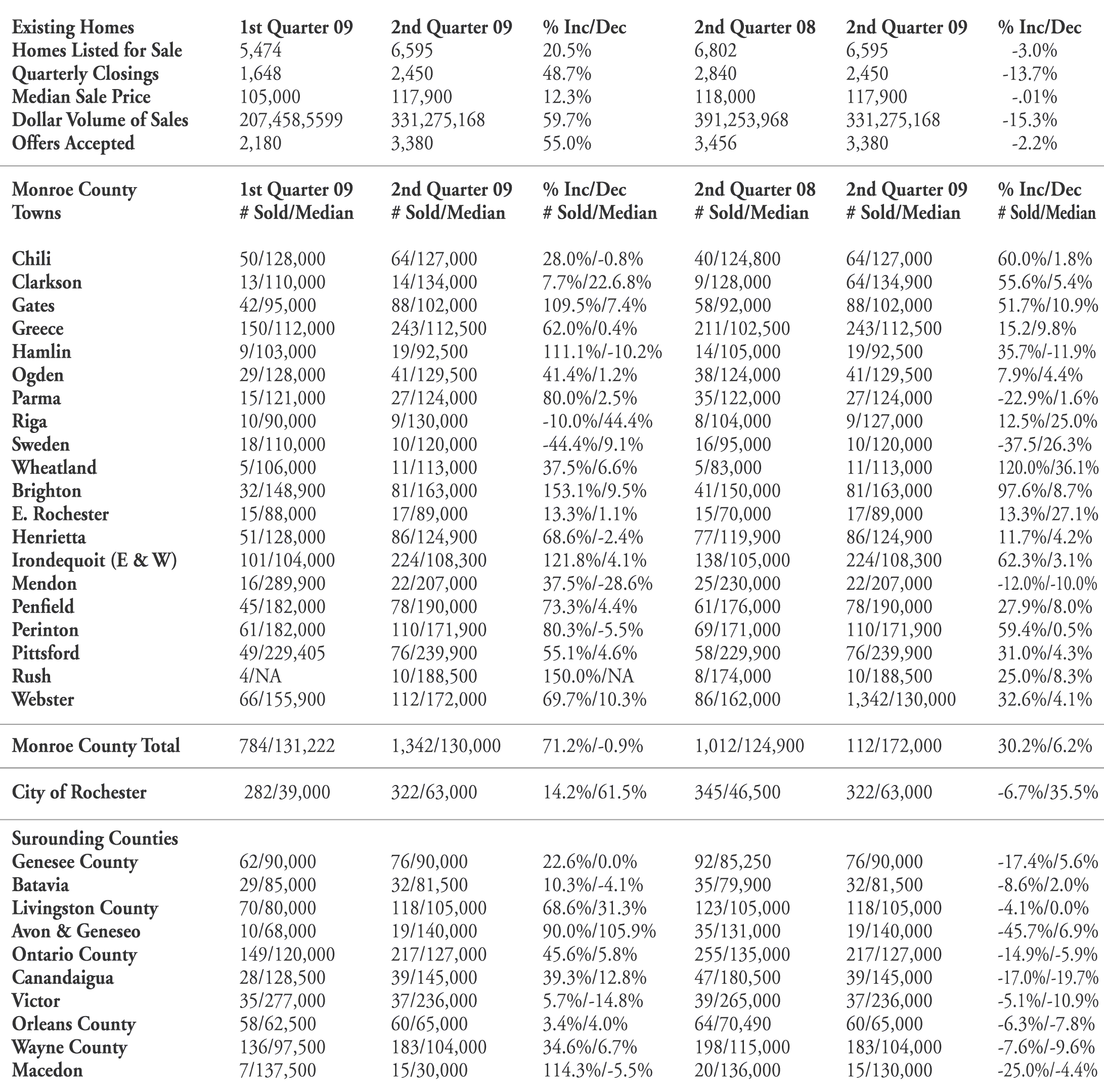
Statistics released by the Genesee Region Real Estate Information Services (GENRIS), the information subsidiary of the Greater Rochester Association of REALTORS® (GRAR), showed that the housing market in the 12-county region remained relatively stable.

Transactions for the Second Quarter were holding steady with 2,450 homes sold. Although that figure points to a 13.7 percent decrease compared to Second Quarter 2008, it is a 48.7 percent increase in contrast to First Quarter 2009. The median sale price of homes remained slightly unchanged at $117,900, when compared to Second Quarter 2008, and increased 12.3 percent over First Quarter 2009. Pending sales were down slightly at 2.2% from Second Quarter 2008 but up a whopping 55 percent over First Quarter 2009. The number of homes listed was at 6,595 and consistent when compared to Second Quarter 2008, down only 3 percent. Closings year-to-date decreased slightly at 17.2 percent compared to 2008.

GRAR also noted that while home sales increased 27.2 percent from First Quarter 2008 to Second Quarter 2008, that was pale in contrast when comparing First Quarter 2009 to Second Quarter 2009, which showed a 55 percent increase. GRAR officials believe the surge may be as a result of the First Time Home Buyers Tax Credit. Although the program is scheduled to conclude on November 30, 2009, GRAR wants to remind prospective first-time home buyers that it could take anywhere from 60 to 90 days to close on a home. In order to take advantage of the tax credit, buyers should be under contract by mid-September. Additionally, inventory in the traditional first-time buyer sector is expected to tighten as the tax credit deadline nears, which will make finding the right home more difficult.

There were several towns within Monroe County which realized a significant increase in home sales over First Quarter 2009. They included: Gates, Greece, Brighton, Henrietta, Irondequoit, Perinton, Pittsford, and Webster.

What we are seeing is a resurgence of optimism in the local real estate market,” said Ryan Tucholski,

GRAR Chief Executive Officer. “We are especially excited about the increases over last quarter.”

Tucholski also stated that people still consider homeownership a wise investment because of the stability in home values in our local market. This is also true for sellers because they are not losing money on the sale of their homes.

Chuck Hilbert, president of the GRAR Board of Directors said that that the First-Time Homeowners Tax Credit has been well-received and has helped to drive the local market.

“Our average and median sale prices demonstrate the stability of our market,” Hilbert remarked. “We want people to know that with the First Time Homebuyer Tax Credit and low interest rates, this is an ideal opportunity to purchase a home.”

GRAR recently launched its new Time 2 Buy marketing campaign that focuses on the benefits of owning a home and why now is a good time to buy.

Hilbert stated that the National Association of REALTORS, the New York State Association of REALTORS, and many individual associations, including GRAR, are focusing their lobbying efforts on extending the First Time Homebuyer Tax Credit into 2010.

“We don’t want to stop the momentum that we’ve started,” said Hilbert. “It’s critical that we move the real estate industry forward. That is the message we must continue to send to our legislators, if we are to ensure the well being of our local and national economy.”

Click image to see full size.

Builders Remain Confident With Lower Numbers

Monday, August 3rd, 2009

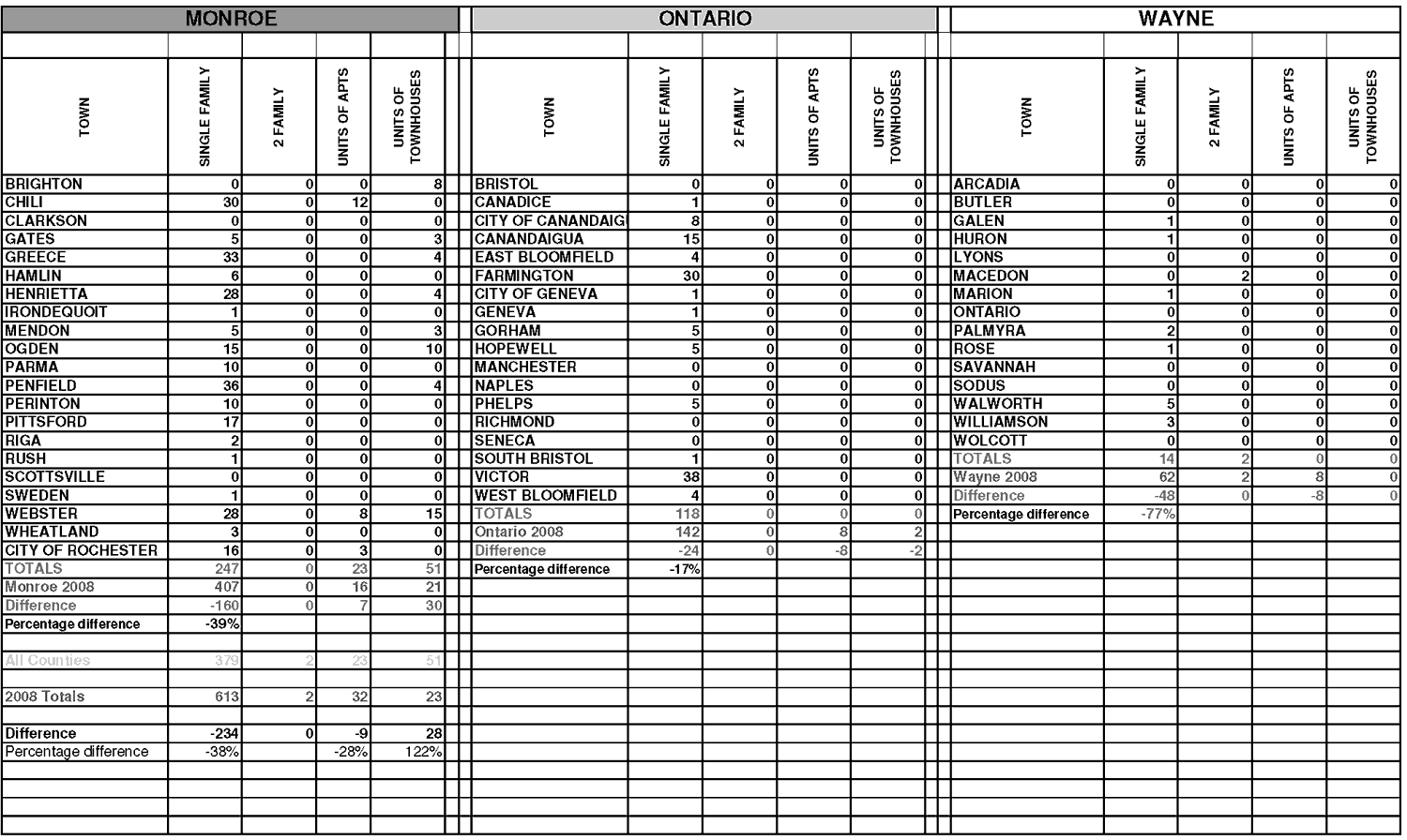
Despite a lower number of permits being issued in the greater Rochester area the first half of 2009, builders remain optimistic for the remainder of the year and beyond.

New home building permits were down over 35%. An unusually snowy winter and unsettled national economy is to blame. “The winter months were long and hard on our industry and the lack of consumer confidence due to the national economic uncertainty early this year has not helped our local industry,” said Dawn Aprile, Chairman of the Rochester Home Builders’ Association and President of Premium Development Corporation. “Many local businesses were affected by the national economy. It has just been recently that we are seeing consumers realizing how solid the housing market is in the greater Rochester area and they are now looking to take advantage of the market,” Aprile said.

“Rochester is a pre-sold market.” said Rick Herman, Chief Executive Officer of the Rochester Home Builders’ Association. “The housing market is good in Rochester compared to the rest of the country. We have a very well balanced market, prices remain stable, and values rarely drop.  Housing is a secure investment in our area.” Herman added.

Some products are moving faster than others when it comes to new home sales. The starter market is experiencing a brisk business due to the $8,000 Federal Tax Credit and the “downsizing” of homes also seems to be solid. The Greater Rochester Area has experienced an “adjustment” or “soft landing” when it comes to new homes. Builders are confident that as consumer confidence is regained, the market will take off again in 2010 with stronger numbers.

In 2009 the Rochester Home Builders’ Association (RHBA) and its nearly 400 business members are celebrating the association’s 75th anniversary. Incorporated in 1934 the Rochester Home Builders’ Association is one of the original eight associations that helped to form the National Association of Home Builders (NAHB) in Washington, D.C.  Seventy five years later NAHB has more than 800 chapters across the country, and the Rochester Home Builders’ Association is one of the strongest and most active of the 16 chapters in New York State. The RHBA is a trade association of home builders, remodelers, general contractors, trades, suppliers, lending institutions and many other businesses that support the building and remodeling industries. Find out more at www.rochesterhomebuilders.com

Click image to see full size.